







This article was written by Serge, MSc. Plant Biologist and Environmental Scientist with a BSc in Plant Biology and an MSc in Environmental Biology and Biogeochemistry. My research focused on climate change effects on boreal forest ecosystems. I write from field experience, not just literature.
Affiliate disclosure: This site has affiliate links, including Amazon. As an Amazon Associate I earn from qualifying purchases, at no extra cost to you.

Microplastics are not a future problem. They are a present one. And the research coming out of post-mortem brain tissue analysis is some of the most striking contamination data I have encountered since studying how pollutants move through biological systems.
My ecotoxicology training covered the mechanisms by which environmental contaminants cross biological barriers, accumulate in tissue, and interact with cellular systems. The microplastic story connects directly to that framework. These are not inert particles sitting passively in tissue. They are chemically active surfaces carrying adsorbed contaminants into some of the most sensitive biological environments in the human body.
What the 2024 Research Actually Found
A study led by Matthew Campen at the University of New Mexico compared post-mortem brain tissue samples collected in 2016 and 2024. The findings were striking. Brain tissues collected in 2024 contained roughly seven times more microplastic particles than liver or kidney tissue from the same individuals. The concentration measured was approximately 4,800 micrograms of plastic per gram of brain tissue.
The same research noted that individuals with dementia had three to five times higher microplastic concentrations in brain tissue than individuals without dementia. The particles were found accumulating in blood vessels and brain immune cells specifically.
The researchers were careful to note that the association between microplastics and dementia does not establish causation. The particles may accumulate more readily in tissue already compromised by neurodegeneration rather than causing the neurodegeneration themselves. That distinction matters and the research literature does not yet resolve it.
What the data does establish clearly is that microplastic accumulation in human brain tissue is increasing measurably over time and that the brain accumulates these particles at higher concentrations than other organs.
How Microplastics Cross the Blood-Brain Barrier
The blood-brain barrier is a selective membrane formed by specialised endothelial cells lining the brain’s capillaries. It prevents most large molecules and many pathogens from entering brain tissue while allowing essential nutrients through.
Nanoplastics, particles smaller than one micrometre, are small enough to cross this barrier through transcytosis, the same mechanism by which the barrier transports certain nutrients. Size is the critical variable. Larger microplastic fragments are filtered by other organs before reaching the brain. Nanoplastics, formed as larger plastic fragments continue to degrade, are the fraction most relevant to brain accumulation.
My ecotoxicology coursework covered how lipophilic pollutants, those with an affinity for fat-based tissue, accumulate preferentially in organs with high lipid content. The brain is approximately 60 percent lipid. Plastic polymers and the chemical additives adsorbed onto plastic surfaces share this lipophilic character. The affinity of plastic-associated compounds for lipid-rich tissue follows from basic partitioning chemistry.
The Chemical Dimension
Microplastics are not chemically inert. They carry adsorbed contaminants on their surfaces and leach chemical additives from their polymer matrix.
The most concerning compound classes associated with microplastics include phthalates, used as plasticisers in flexible plastics, bisphenol compounds used in polycarbonate production, and PFAS, per and polyfluoroalkyl substances used in coatings and packaging. All three compound classes are documented endocrine disruptors with effects on hormone signalling systems.
My ecotoxicology training covered endocrine disruption mechanisms in detail. These compounds interfere with hormone receptor binding, alter hormone synthesis, and affect the regulation of developmental and reproductive processes. The presence of endocrine-disrupting compounds in brain tissue, an environment with extensive hormonal signalling activity, raises questions that the current research has not yet fully addressed.
The concentration of these adsorbed contaminants on nanoplastic surfaces can exceed their concentration in the surrounding environment through a process called concentration factor accumulation. Smaller particles have higher surface area to volume ratios, meaning nanoplastics carry proportionally more adsorbed contaminants per unit mass than larger microplastic fragments.
Where Microplastics Come From
Understanding the environmental pathways that produce nanoplastics is part of what makes this an ecotoxicology problem rather than just a consumer health story.
Plastic degradation in the environment is driven by UV radiation, mechanical abrasion, and microbial activity. Each of these processes fragments larger plastic items into progressively smaller particles. The degradation does not eliminate the plastic. It redistributes it into smaller and smaller fragments with increasing surface area and increasing mobility through environmental systems.
Secondary microplastics, those formed by the degradation of larger plastic items rather than manufactured at small size, now dominate environmental plastic contamination. They enter water systems through runoff, are transported through atmospheric deposition, and accumulate in soil where degradation continues to produce nanoplastic fractions.
My atmosphere-biosphere exchange coursework covered how particles move between environmental compartments. The atmospheric transport of microplastics follows similar physical principles to the transport of dust and aerosol particles. Nanoplastics are light enough to remain airborne and be deposited far from their source. This is why microplastics are now detected in remote environments including arctic ice and high altitude soils with no local plastic sources.

What This Means for Environmental Science
The microplastic accumulation story is fundamentally an environmental contamination story that has reached a biological endpoint we can measure directly in human tissue.
The same ecotoxicological principles that apply to other persistent environmental contaminants apply here. Persistence in the environment, bioaccumulation in tissue, biomagnification up food chains, and chemical toxicity through endocrine disruption are all documented properties of plastic-associated contamination.
What makes microplastics distinctive is their physical as well as chemical activity. Unlike dissolved chemical contaminants, plastic particles are solid surfaces that can physically interact with cellular membranes, accumulate in specific tissue compartments, and carry multiple chemical contaminants simultaneously.
The trajectory of accumulation in brain tissue increasing sevenfold in eight years is a contamination signal that environmental scientists take seriously regardless of whether the health consequences are yet fully characterised. In ecotoxicology you do not wait for complete mechanistic proof before treating an accumulating contaminant as a concern.
Common Questions
What are microplastics and how are they formed?
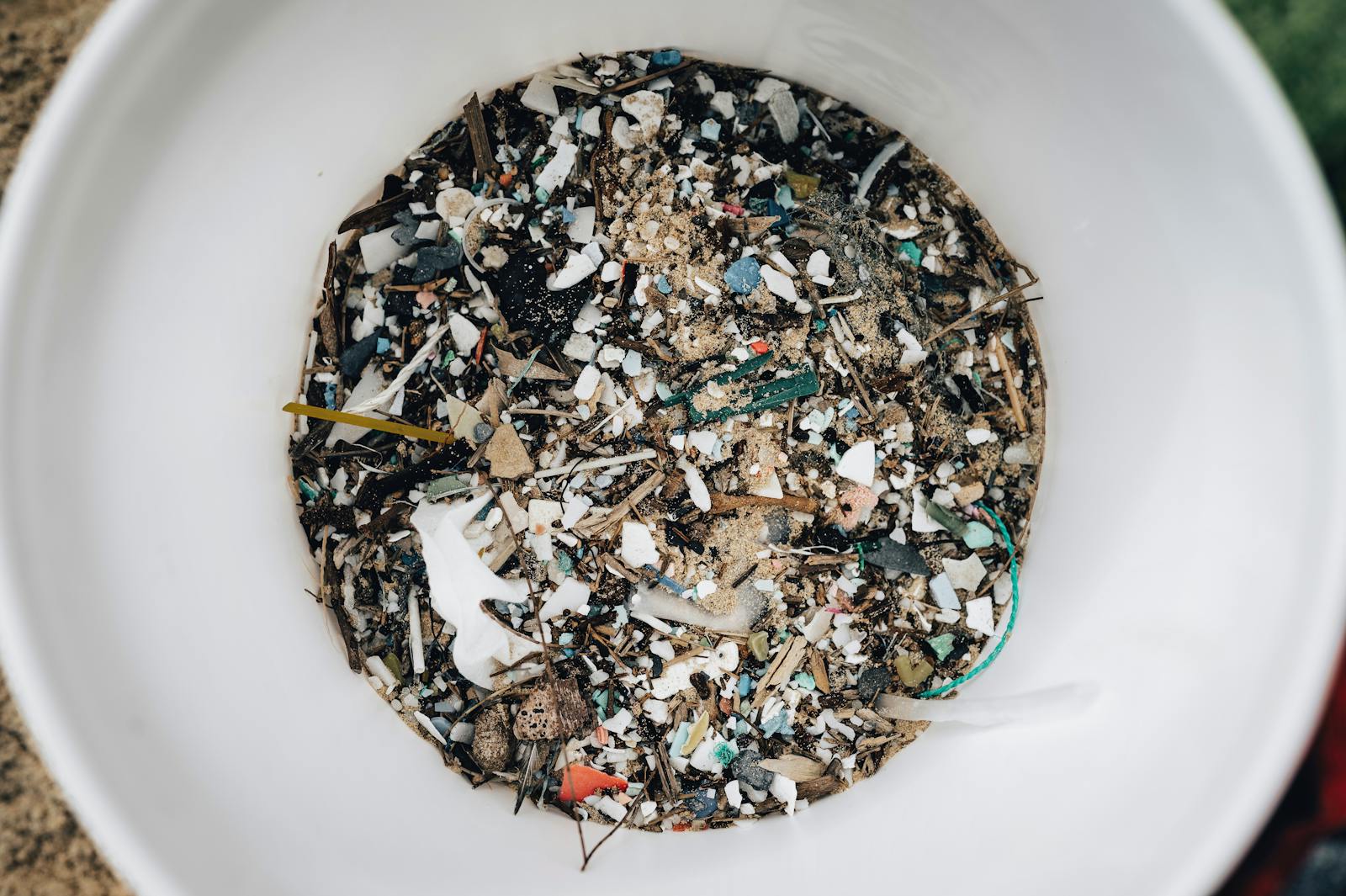
Microplastics are plastic particles smaller than 5 millimetres. Primary microplastics are manufactured at small size for use in cosmetics and industrial applications. Secondary microplastics form through the environmental degradation of larger plastic items by UV radiation, mechanical abrasion, and microbial activity. Nanoplastics, smaller than one micrometre, form as degradation continues and are the fraction most relevant to biological accumulation in sensitive tissues.
How do microplastics get into the brain?
Nanoplastics are small enough to cross the blood-brain barrier through transcytosis, the same transport mechanism used by certain nutrients. Their lipophilic character means they have an affinity for the brain’s high lipid content. Larger microplastic fragments are filtered by other organs before reaching the brain.
What did the 2024 brain tissue research find?
Research led by Matthew Campen at the University of New Mexico found that human brain tissue collected in 2024 contained approximately seven times more microplastic particles than liver or kidney tissue from the same individuals. Concentrations had increased measurably compared to samples collected in 2016. Individuals with dementia showed three to five times higher concentrations than those without, though causation has not been established.
Are microplastics chemically active in tissue?
Yes. Microplastics carry adsorbed contaminants including phthalates, bisphenol compounds, and PFAS on their surfaces and leach chemical additives from their polymer matrix. These compound classes are documented endocrine disruptors. Nanoplastics have higher surface area to volume ratios than larger fragments, meaning they carry proportionally more adsorbed contaminants per unit mass.
Why does the brain accumulate more microplastics than other organs?
The brain is approximately 60 percent lipid. Plastic polymers and their associated chemical additives share a lipophilic character, meaning they partition preferentially into fat-rich tissue. This follows from basic environmental partitioning chemistry that applies to lipophilic contaminants generally.
How do microplastics travel through the environment?
Secondary microplastics enter water systems through runoff and are transported through atmospheric deposition. Nanoplastics are light enough to remain airborne and be deposited far from their source through atmospheric transport. This explains why microplastics are detected in remote environments including arctic ice and high altitude soils with no local plastic sources.
What is the difference between microplastics and nanoplastics?
Microplastics are particles smaller than 5 millimetres. Nanoplastics are a subset smaller than one micrometre, approximately one millionth of a metre. The size distinction matters biologically because nanoplastics are small enough to cross the blood-brain barrier and penetrate cellular membranes in ways that larger microplastic fragments cannot.
What chemical compounds are most concerning in microplastic contamination?
Phthalates used as plasticisers in flexible plastics, bisphenol compounds used in polycarbonate production, and PFAS used in coatings and packaging are the most studied compound classes. All three are documented endocrine disruptors with effects on hormone receptor binding, hormone synthesis, and developmental and reproductive processes.
